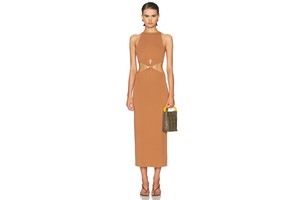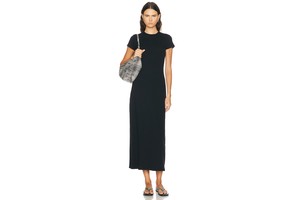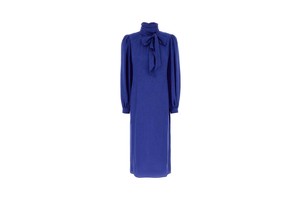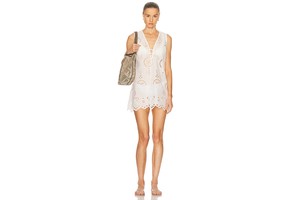
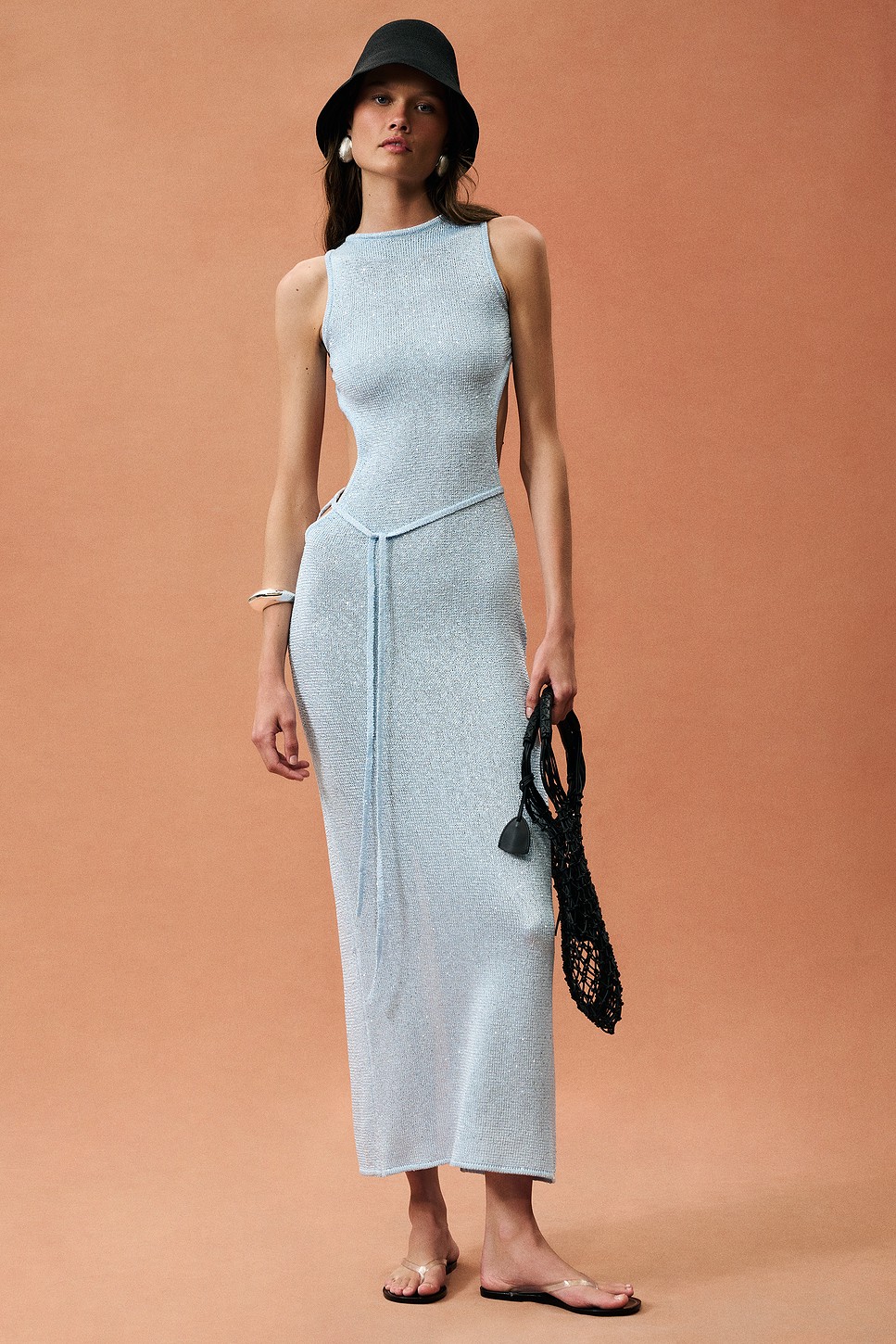
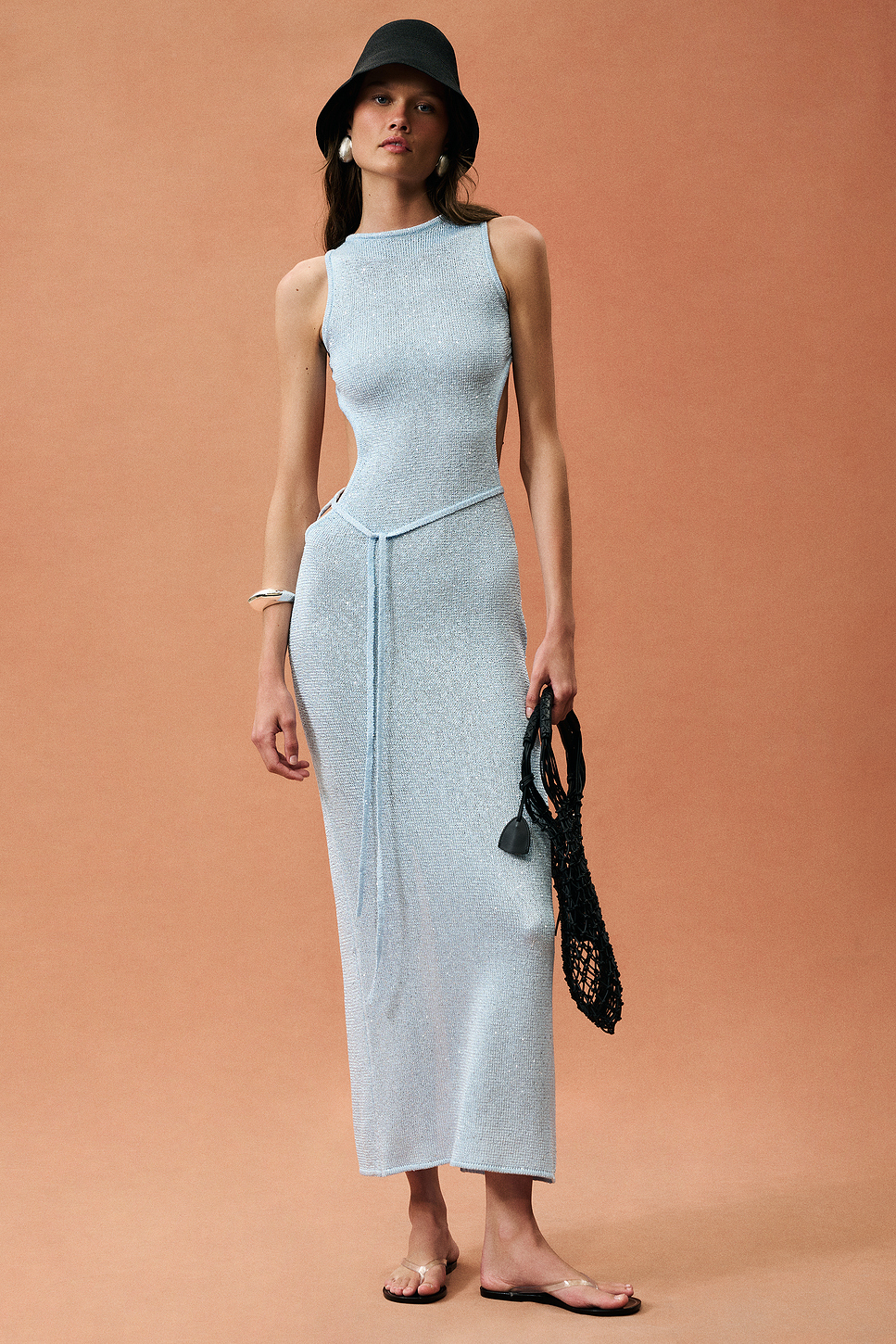
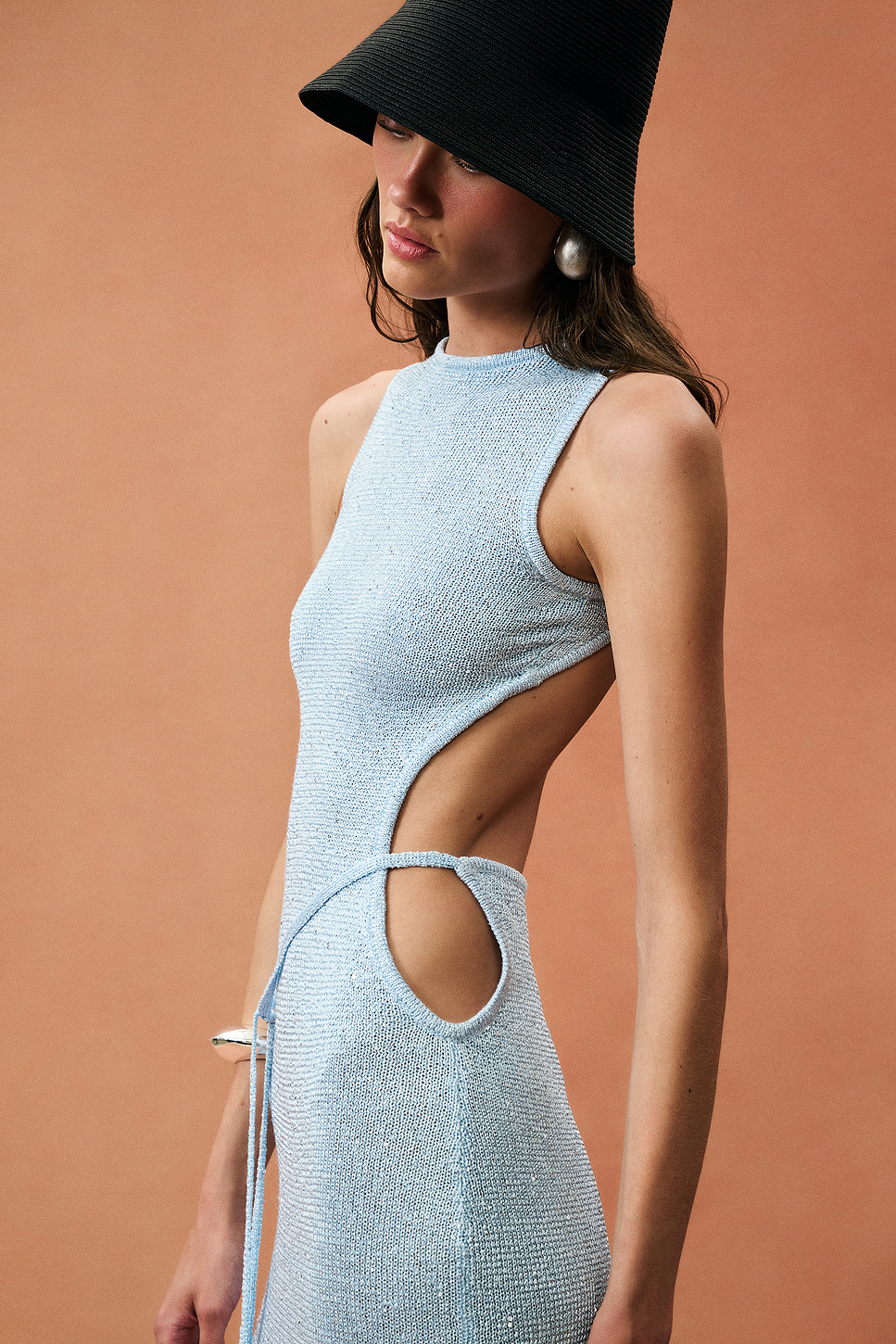
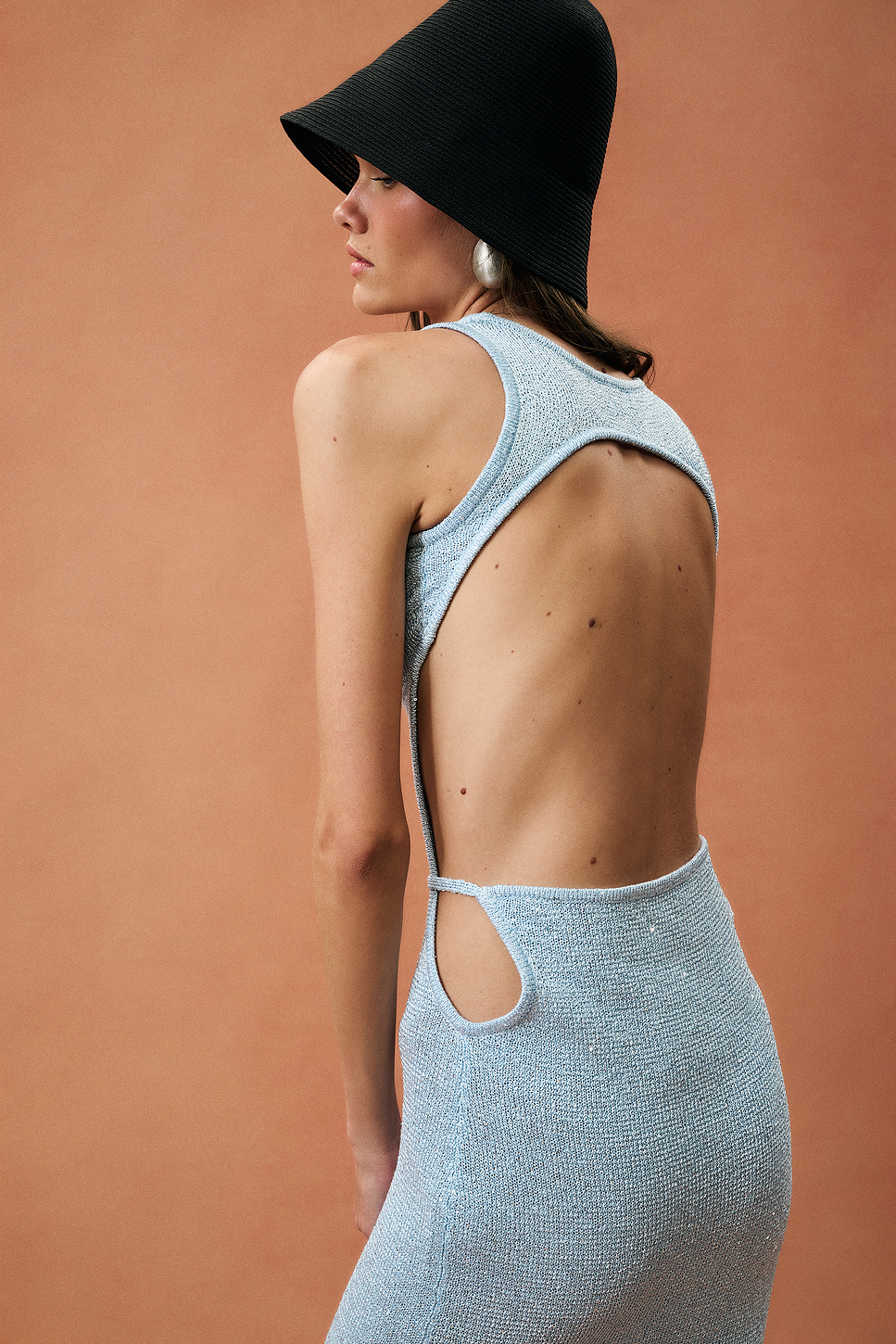
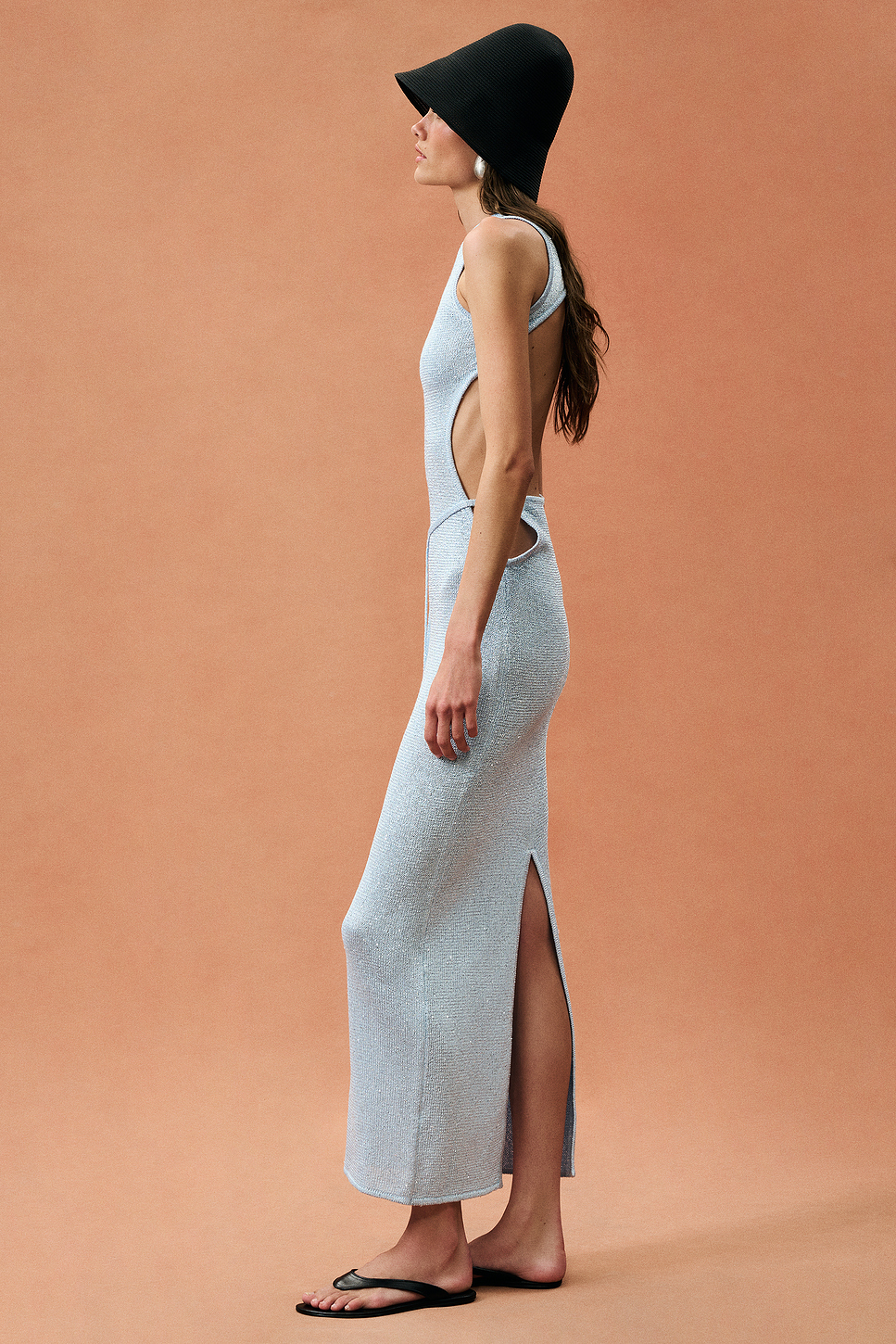
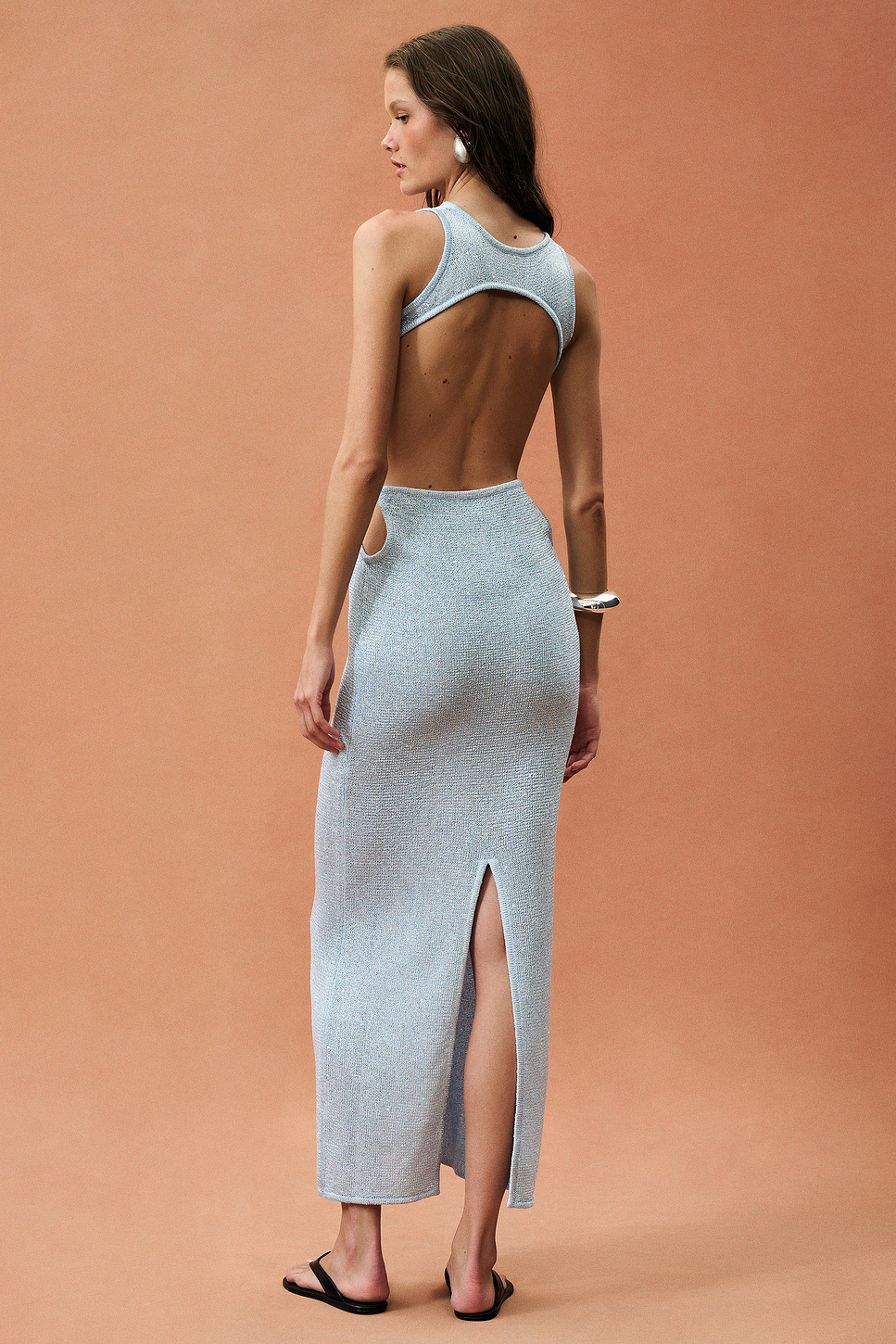
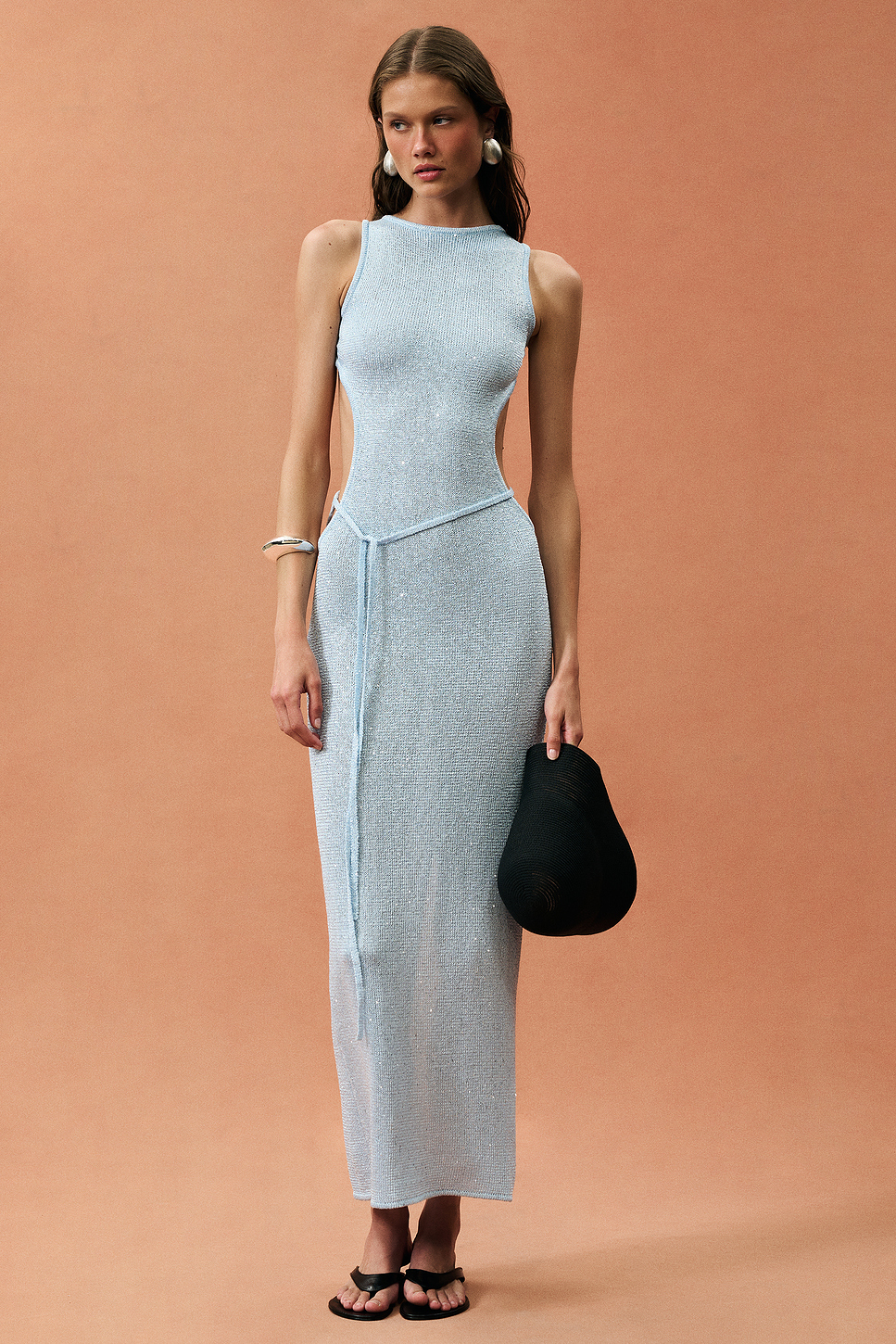
A maxi dress listed as 71% polyester with 29% cotton in a midweight fully fashion knit, unlined, pullover with a self-tie at the back, dry clean only, made in China, at 378 dollars. There are no reviews and no fit votes, so there is no score to quote. There are two knits in this group and comparing them is useful, because they are both knits and they get their stretch in the same way and that is the whole point. But the reason this one is worth writing about is a single phrase in the fabric description that most people will read past, and which actually tells you a great deal about how the garment was made and what it will cost to make. It also places this dress at one end of a spectrum of material waste that this series has already shown the other end of, and the distance between the two is worth appreciating. There is a practical point about a tie at the back, which we can now compare against two other positions we have covered, and a care instruction that does not fit the garment it is on. The reference is the for FWRD Tie Maxi Dress by SAME in Light Blue. Dongguan Bafinasa Garments Co., Ltd. develops comparable knit dresses on OEM and ODM terms, from yarn sourcing to retail or FBA ready packing. We publish this as a development reference and build your own version of it, and we do not supply the branded original or reproduce anyone else's label.
Key Features
- 71% polyester, 29% cotton as stated
- Midweight fully fashion knit fabric as stated
- Pullover as stated
- Self-tie at the back as stated
- Unlined as stated
- Dry clean only as stated
- Five sizes from XS to XL
- Maxi length
Customisable Options
- Fabric: polyester cotton fully fashion knit as the reference, with yarn and gauge set from a tested sample
- Tie: as the reference, and we would consider moving it, for the reason set out below
- Care: we would test whether dry cleaning is actually required, for the reason set out below
- Sizes: we would publish a chart, which this listing does not
- Length from midi to floor, size set, colour development, private label and care labelling
Specifications
| Style | Tie back maxi knit dress |
| Reference | SAME, for FWRD Tie Maxi Dress, style SMXF-WD7, manufacturer style TIE MAXI DRESS, colour Light Blue |
| Composition | 71% polyester, 29% cotton as stated |
| Fabric | Midweight fully fashion knit fabric as stated |
| Knit Note | Fully fashion means the panels are knitted to shape on the machine rather than cut from cloth. See the note below |
| Closure | Pullover with a self-tie at the back as stated |
| Lining | Unlined as stated |
| Care | Dry clean only as stated |
| Sizes Published | XS, S, M, L, XL |
| Size Chart | No measurements published on this listing |
| Model | 183 cm, wearing size S, bust 81 cm, waist 61 cm, hips 89 cm |
| Production | Made in China as stated |
| Reference Retail | 378 USD, quoted to show the price band this sits in, not as our price |
| Customer Reviews | None on the reference listing, so we quote no score |
| Best Seller Badge | None. The listing carries no rank |
| Categories | Filed by the retailer under both maxi dresses and tank dresses |
| Occasion | Daytime, holidays, warm weather, layering |
| MOQ | 100 pcs per style per colourway, mixed sizes and colourways accepted |
| Sampling | 7-10 days after tech pack or reference sample confirmation |
| Bulk Lead Time | 20-30 days after sample approval and deposit |
| Service | OEM / ODM / private label, knit development and yarn sourcing, retail or FBA ready packing |
Size Chart
| Size | Bust | Waist | Hips | Length | Source | ||||||||||||
|---|---|---|---|---|---|---|---|---|---|---|---|---|---|---|---|---|---|
| XS | 31 | in / | 79 | cm | 24 | in / | 61 | cm | 34 | in / | 86 | cm | 145 | cm / | 57.1 | in | Our proposal |
| S | 33 | in / | 84 | cm | 26 | in / | 66 | cm | 36 | in / | 91 | cm | 147 | cm / | 57.9 | in | Our proposal |
| M | 35 | in / | 89 | cm | 28 | in / | 71 | cm | 38 | in / | 97 | cm | 149 | cm / | 58.7 | in | Our proposal |
| L | 37 | in / | 94 | cm | 30 | in / | 76 | cm | 40 | in / | 102 | cm | 151 | cm / | 59.4 | in | Our proposal |
| XL | 39 | in / | 99 | cm | 32 | in / | 81 | cm | 42 | in / | 107 | cm | 153 | cm / | 60.2 | in | Our proposal |
This listing publishes no size chart, which is a gap we would not repeat. It is worth noting that a knit is the one category where the absence is most defensible, since a knit accommodates more shapes than a woven cloth does, but that is a reason to explain the absence rather than to leave it unexplained. A customer who sees no chart assumes the page is incomplete, not that the garment is forgiving.
Occasions and Styling
Suits daytime, holidays, warm weather and layering. A knit maxi with a tie at the back is a relaxed warm weather piece, and it is worth photographing the tie from behind, since that is the detail the customer cannot see for herself.
Production and Quality Control
There are no reviews and no fit votes on this listing, so there is no score to quote. There is a phrase in the fabric description that carries more information than it appears to, a tie in a position we can now compare against two others, and a care instruction that does not match the garment.
Fully fashion is a specific way of making a knit and it changes the economics, and that is the first thing, and it is the most interesting thing on this page. Most garments are cut: cloth comes off a roll, a pattern is laid on it, and pieces are cut out, and what is left over is waste. A knit can be made that way too, knitted as a continuous length of cloth and then cut. But fully fashion means something different, and it is worth being precise about it, because it is not a marketing word. In fully fashion knitting, the panels are knitted to their finished shape on the machine: the machine increases and decreases stitches at the edges so that what comes off it is already the shape of a bodice or a sleeve, with a finished edge that will not unravel. Nothing is cut away afterwards, because there is nothing to cut. Now consider what that does to waste, because this series has recently given us the other end of the scale to compare against. We covered a leather dress not long ago, and the point there was that leather is cut from irregular skins carrying scars and variations, and the cutter has to work around all of it, so cutting waste on leather runs far higher than the ten or fifteen per cent you might allow on cloth, and that difference sits in the unit cost before anyone sews a seam. Fully fashion knitting is the opposite extreme: the yarn that goes in is essentially the garment that comes out. The two are worth holding together, because they show how much of a garment's cost is decided by how it is made rather than by what it is made of. There are other consequences worth knowing. A fully fashion panel has a shaped, finished edge, so there is no raw edge to neaten and no seam allowance consumed at the boundary, which changes how the pieces are joined. And the shape is set by the machine programme, so a design change means a new programme rather than a new pattern, which has implications for how you sample and how quickly you can iterate.
A knit without elastane will relax, and that is the second thing, and it is the main technical caution on this garment. There are two knits in this group and they get their stretch the same way, which is structurally rather than from the fibre: a knit is made of interlocking loops, and pulling on it opens the loops, so it stretches whether or not there is any elastane in the yarn. So the stretch is real and this garment being a pullover with no zip is coherent, because a knit will pass over the body. But there are two kinds of stretch, and only one of them is useful. The first is whether it stretches when pulled. The second, and the one that matters over a season, is whether it comes back. Without elastane in the yarn, a knit recovers less well, and what that means in wear is that it does not return to its original shape: it grows a little each time it is worn, and it bags at the places that are worked hardest, which on a long dress means the seat and the knee. That is the failure mode to test for, and it is not visible on a hanger, only on a body that has worn the garment for a few hours. So we would wear test this and check whether it recovers overnight. If it does not, the answer is not to abandon the fabric but to put a little elastane into the yarn, because even two or three per cent converts a knit that relaxes into one that recovers, and it does not change how the garment looks or feels. The composition here is 71% polyester with 29% cotton, and the cotton is worth noting: it will crease, and a knit with that much cotton in it creases more than most people expect from something they think of as jersey.
A tie at the back is the third thing, and we now have three positions to compare, which makes the point rather well. We have covered a tie at the side, on a silk wrap dress, where we liked the position and worried instead about silk being too slippery to hold a knot. We have covered a button and loop at the back of the neck on a halter, and we were hard on it, because it is behind the head where it cannot be seen and it catches hair. This one puts the tie at the back of the body. That is better than the back of the neck, because it is within reach and she can feel what she is doing, and it is worse than the side, because she cannot see it at all. But the specific caution with a tie at the back is not about tying it, it is about sitting on it. A knot sitting at the back of the waist is exactly where a chair back presses, and it will dig in, and on a long drive or a long dinner it becomes genuinely uncomfortable. It also flattens and creases under her, so it does not look right once she stands up. That is the sort of thing nobody discovers from a photograph, because nobody photographs a customer sitting down. We would either move the tie to the side, where it is both visible and clear of the chair, or make it decorative and put the actual closure somewhere else. One further note on the position: this is a maxi, so the tie is not carrying the garment, and moving it is a small change.
Dry clean only on a knit is the last thing, and it does not fit. We have spent this series arguing that care instructions get set by looking at the shell fabric and never checked against anything else, and this is a case where the instruction looks set by caution rather than by testing. The composition is 71% polyester, and polyester is one of the most washable fibres there is: it does not shrink, it does not felt, it tolerates warm water and it dries quickly. A knitted polyester cotton dress is, on the face of it, one of the easiest garments in a wardrobe to look after. Requiring it to be dry cleaned imposes a real cost on the customer in money and in inconvenience, every single time she wears it, and on a casual maxi that she might wear weekly through a summer that is a serious burden. It is possible there is a reason: a tie, an unlined construction with particular edges, a yarn that behaves unexpectedly. But none of that is stated, and the suspicion is that nobody tested it. We would test it, and if it washes, say so, because a washable knit maxi is a considerably easier garment to sell than one that needs a cleaner. And if hand wash is the honest answer, write hand wash rather than dry clean only, which is a different level of burden again. This is worth stating as a principle because it runs through this whole series: a care instruction that is stricter than it needs to be is not a cautious choice, it is a cost the customer pays and a sale you may not make. Every bulk shipment gets a measurement report against your approved chart.
Optional upgrades include a little elastane in the yarn for recovery, a wear test for bagging at the seat and knee, the tie moved to the side or made decorative, the care instruction tested rather than assumed and possibly changed to washable, a published size chart with a note on why a knit is forgiving, a defined yarn and gauge, alternative necklines and tie treatments, alternative lengths, extended sizing, colour development and private label, hangtag and care labelling.
Pre-production sample approval, in-line inspection during cutting and sewing, and a final AQL inspection before packing, with measurement reports and photos shared before shipment.
Send us your tech pack, a photo or a reference garment and we will quote within 24 hours. Contact bafinasa@bafinasa.com or WhatsApp +86 13827222469.